Published in · FSE Companion 2026, Montreal
A Vision for Context-Aware CI Adoption Decisions
Written by Osamah H. Alaini
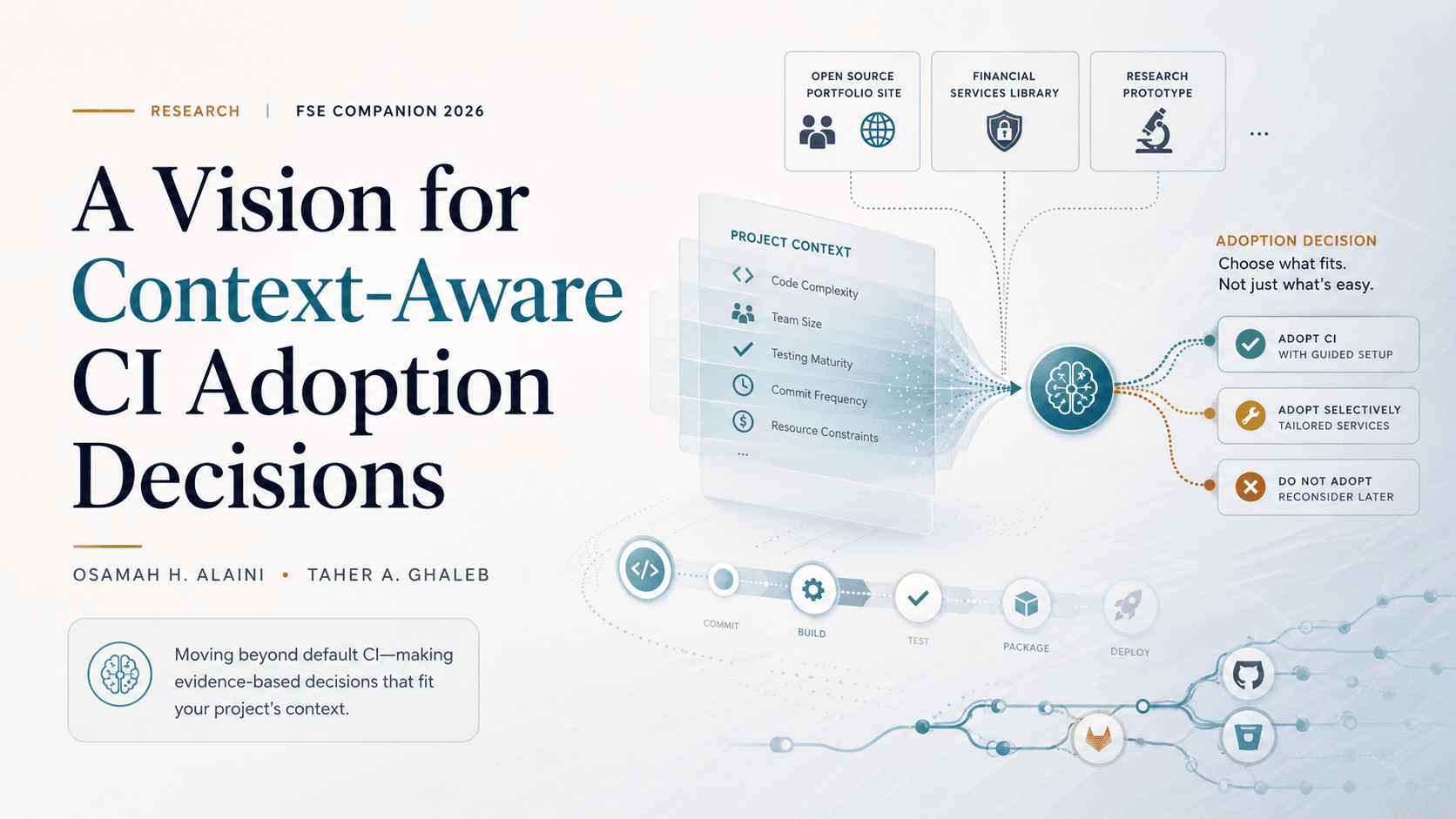
Continuous Integration has become so easy to enable that many teams never pause to ask whether it actually fits their project. Our FSE Companion 2026 paper argues CI adoption should be a deliberate, evidence-based decision, not a default.
Abstract
Continuous Integration (CI) is widely adopted in modern software development, yet adoption decisions are often made without systematic consideration of project context. Platforms such as GitHub Actions lower the barrier to CI adoption but provide limited support for grounding adoption decisions in project characteristics, leading to redundant services, unmaintained workflows, and costly migrations. Existing research and tooling primarily focus on improving CI after adoption, offering little guidance for assessing suitability before adoption. As a result, CI is frequently treated as universally beneficial rather than context-dependent. This paper envisions a shift from default CI adoption to deliberate, context-aware decision-making. We propose an AI-enabled framework that assesses whether projects are likely to benefit from CI, recommends suitable CI services based on project characteristics, and provides configuration guidance tailored to project needs. We outline a research agenda combining developer studies, large-scale repository mining, and recommendation system design to enable informed CI adoption decisions and prevent inefficiencies before they occur.
FSE Companion 2026, Montreal
I am pleased to share that our paper, "A Vision for Context-Aware CI Adoption Decisions," was presented at FSE Companion 2026 in Montreal, as part of the ACM Joint European Software Engineering Conference and Symposium on the Foundations of Software Engineering. The work was co-authored with Professor Taher A. Ghaleb.
The problem with default CI adoption
The motivation behind this paper is simple: Continuous Integration has become so easy to enable that many teams never pause to ask whether it actually fits their project. One click, and GitHub Actions is running. But convenience does not always mean suitability. In practice, nearly a quarter of CI adoptions are later abandoned, and developers often spend valuable time experimenting with pipelines that were never a good match in the first place.
Our argument is that CI adoption should be a deliberate decision, not a default.
Before a team commits time and resources, the project context should guide three questions:
- Should this project adopt CI at all?
- Which CI service best fits the project?
- How should the workflow be configured?
A vision for context-aware recommendations
The paper presents a vision for an AI-enabled recommendation framework that can answer these questions early, before teams invest in the wrong setup. The goal is not just to automate a choice, but to provide explanations developers can understand and trust.
The research agenda is structured around three stages:
- Understanding how developers currently make CI adoption decisions
- Mining repositories to connect project characteristics with adoption outcomes
- Building an empirically grounded recommendation system
The broader goal is to replace reflexive defaults with evidence-based decisions and to prevent wasted effort before it happens.
Acknowledgment
I am deeply grateful to Professor Taher A. Ghaleb for his mentorship and support throughout this work. He taught me how to turn a research idea into a clear, meaningful vision, and that lesson will stay with me well beyond this paper.
Topics